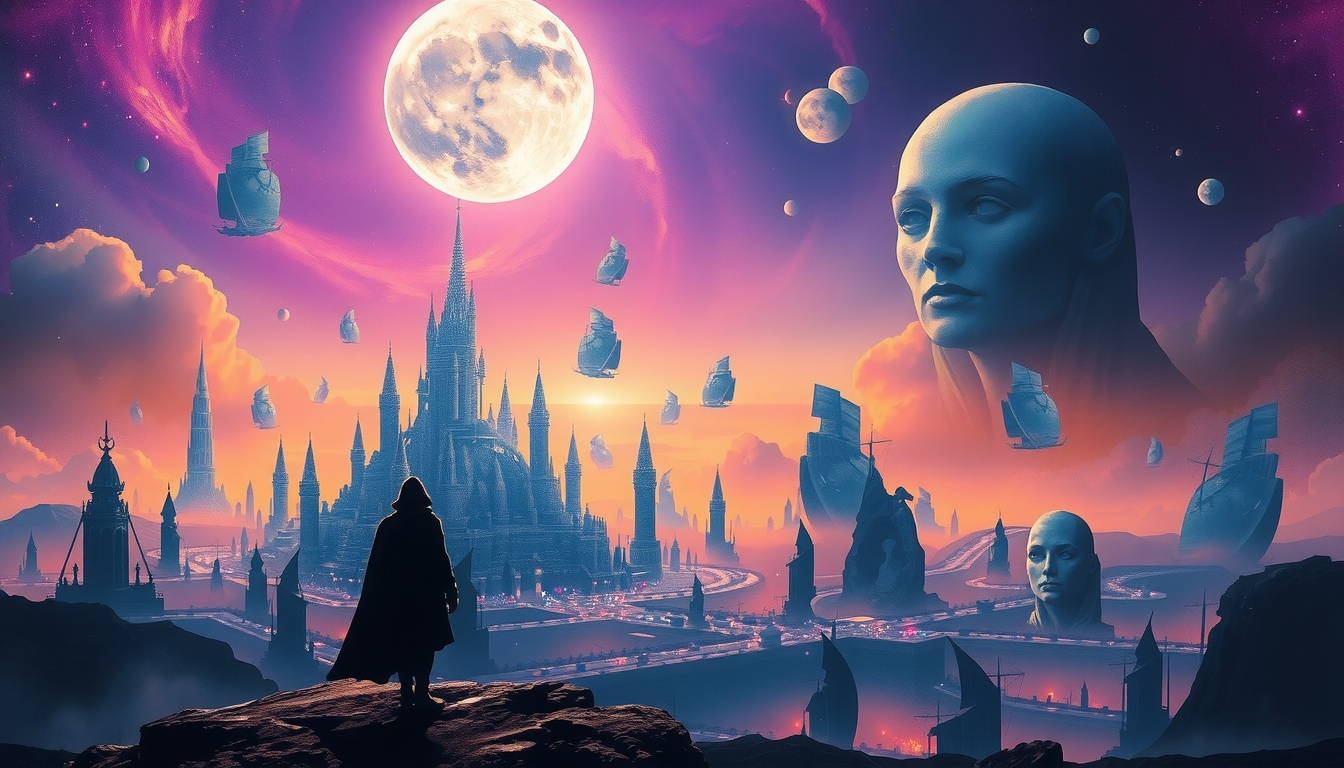
Imagine a universe where every decision you make creates a ripple, branching out into countless possibilities. This is the enchanting allure of the multiverse theory—a concept that transforms our understanding of existence by suggesting that each choice spawns alternate realities. It’s a mind-bending idea that has captured the curiosity of scientists, philosophers, and storytellers alike, as they ponder the implications of infinite universes coexisting simultaneously.
As we embark on this exploration, we delve into the profound notion that our everyday decisions might not just affect our current reality but could be crafting entirely new ones. Each “what if” carries the potential to unravel an alternate path, expanding the tapestry of existence in ways we can scarcely imagine. Through the lens of quantum physics and philosophical inquiry, we’ll examine how these alternate realities challenge our perception of free will and destiny.
Join us as we journey through the realms of science and thought, where the boundary between reality and possibility blurs. This exploration promises to stretch your imagination and provoke deep contemplation about the very nature of choice and consequence. Are you ready to explore the infinite landscapes of alternate realities?
Understanding Multiverse Theory
The multiverse theory, a concept that once dwelled in the realm of speculative fiction, has found its footing within the sophisticated corridors of quantum physics. At its core, the multiverse theory suggests that our universe is not alone but rather one of potentially infinite universes existing simultaneously. This idea was first proposed as part of the many-worlds interpretation by physicist Hugh Everett III in the 1950s, which posits that every quantum decision leads to a branching of realities. Essentially, each choice or event could lead to a different outcome, creating parallel universes where every possibility is played out.
The implications of multiple universes coexisting are profound, challenging our understanding of reality itself. If alternate realities indeed exist, this would suggest that every decision-making process we undergo could spawn a new universe where a different choice was made. This fundamentally alters our perception of free will and fate, suggesting a cosmos teeming with endless variations of existence. The multiverse theory invites us to consider the tantalizing notion that there might be worlds where history took different paths, where our lives unfolded in ways we can only imagine.
Key scientific figures have significantly contributed to the development and popularization of multiverse theory. Notable among them is physicist Max Tegmark, who classified multiverse hypotheses into four levels, each increasingly complex and expansive. Furthermore, Brian Greene has brought these ideas into public consciousness through his engaging writings and lectures on parallel universes. These scientists, along with others like Stephen Hawking and Leonard Susskind, have pushed the boundaries of our understanding, exploring the mathematical and philosophical implications of a multiverse.
By examining these theoretical frameworks and the minds behind them, we not only gain insight into the nature of reality but also confront the possibility that our universe is just one thread in an intricate cosmic tapestry. The exploration of multiverse theory not only broadens our scientific horizons but also enriches our philosophical inquiry into the nature of existence and our role within it. As we delve deeper into this mysterious territory, we are reminded of the vastness of what remains unknown and the potential for discovery that lies ahead.
Philosophical Perspectives on Alternate Realities
Philosophical theories have long toyed with the idea of alternate realities, positing a universe where every possibility is played out in its own reality. The concept of interconnected universes not only expands our understanding of existence but also challenges the very notion of individual experience and identity. Philosophers like David Lewis argue for modal realism, which suggests that all possible worlds are as real as the one we inhabit. This perspective raises profound questions about the nature of reality itself, suggesting that each decision may lead to the birth of an entirely new universe where different outcomes unfold.
The existence of alternate realities also forces us to reevaluate our perceptions of free will and destiny. If every possible outcome of a decision is realized in some universe, it could imply that free will is not about choosing a single path, but rather about selecting which version of oneself one becomes. This perspective can be both liberating and daunting, as it suggests that destiny is not a single, predetermined trajectory but a vast web of possibilities that we constantly navigate. Such a view could foster a greater sense of responsibility for our choices, knowing that each decision might ripple across countless universes.
Ethically, the existence of alternate realities presents intriguing dilemmas. If each choice creates a new universe with its own sentient beings, what moral obligations do we have toward these other versions of ourselves and others? Can actions in one universe justify consequences in another? These questions challenge conventional ethical frameworks that are typically grounded in a singular reality. They invite us to consider a more complex moral landscape where the interconnectedness of universes demands a broader, more inclusive ethical outlook.
As we delve into these philosophical perspectives, it becomes clear that the implications of alternate realities extend far beyond theoretical musings. They touch upon fundamental aspects of human existence, prompting us to reflect on the meaning of life, the nature of consciousness, and the potential for infinite growth and understanding. Whether through philosophy or science, the exploration of alternate realities invites us to engage with the profound mysteries of the universe and our place within it.
Quantum Physics and Alternate Universes
At the heart of the multiverse theory lies the enigmatic realm of quantum mechanics, a branch of physics that defies conventional logic and opens the door to infinite possibilities. Quantum mechanics suggests that particles exist in a state of superposition, where they can be in multiple states simultaneously until observed or measured. This foundational principle gives rise to the idea that every possible outcome of a quantum event actually occurs, leading to the creation of branching timelines or alternate universes. In this framework, our universe is just one of countless others, each representing a different set of outcomes based on the myriad choices made at every moment.
A key concept in understanding how alternate outcomes are realized is the wave function collapse. In quantum mechanics, the wave function describes the probabilities of all possible states a system can be in. Upon measurement or observation, this wave function collapses, resulting in a single outcome from many potential ones. This phenomenon suggests that each collapse may give birth to an alternate universe where a different possibility materializes. Thus, every decision we make, no matter how insignificant it seems, could spawn a new universe where the alternative choice was realized, contributing to an ever-expanding multiverse filled with diverse realities.
To grasp these abstract ideas, thought experiments like Schrödinger’s Cat provide a compelling illustration. Schrödinger’s Cat imagines a scenario where a cat is placed inside a sealed box with a radioactive atom that has a 50% chance of decaying and releasing poison, thus killing the cat. Until the box is opened and observed, the cat exists in a superposition of being both alive and dead. This paradox highlights how observation can affect reality at the quantum level and underscores the notion that multiple outcomes can coexist until observed. Such thought experiments illustrate how quantum mechanics not only challenges our understanding of reality but also enriches the multiverse theory by suggesting that each observation or decision splits off into its own universe, forever altering the tapestry of existence.
The Role of Decision-Making in Universe Creation
Imagine standing at a crossroads, with each path leading to a different version of reality. This scenario embodies the intriguing notion that every choice we make could potentially spawn a new universe. According to multiverse theory, each decision might split the timeline, creating alternate outcomes and parallel universes where different versions of ourselves experience the consequences of choices not taken. This reality exploration suggests that our seemingly mundane decisions, like choosing a career or deciding what to eat for breakfast, could have cosmic significance, branching out into countless realities.
The butterfly effect further illustrates how small actions can have monumental impacts on alternate realities. Originally coined in chaos theory, this concept posits that minor events, like a butterfly flapping its wings, can set off a chain reaction leading to significant changes in the future. In the context of multiverse theory, the butterfly effect implies that even the tiniest decision could lead to vastly different alternate outcomes across multiple realities. For example, choosing to help a stranger on the street might lead to forming a life-changing friendship in one universe, while in another, walking past without notice could result in a missed opportunity for connection.
Consider real-life scenarios where different decisions could lead to vastly different outcomes. Take, for instance, the decision faced by J.K. Rowling to continue writing her manuscript for “Harry Potter” despite numerous rejections. In one universe, she perseveres and ultimately achieves global success, altering literary history. In another, she abandons her efforts, and the world never experiences the magic of Hogwarts. Such examples demonstrate how pivotal decisions shape not only our personal narratives but potentially create entire universes where alternate versions of events unfold. This perspective challenges us to reflect on the weight of our choices and their potential ripple effects across an infinite tapestry of realities.
Cultural Interpretations and Representations
The allure of alternate realities has long captivated storytellers, offering a rich tapestry for exploration in both literature and film. From Lewis Carroll’s whimsical “Alice’s Adventures in Wonderland” to Philip K. Dick’s mind-bending “The Man in the High Castle,” alternate realities have provided fertile ground for examining the human condition through the lens of the multiverse theory. These narratives often explore how human choices create divergent paths, reflecting on the myriad possibilities that lie within every decision. In cinema, films like “Sliding Doors” and “The Butterfly Effect” poignantly illustrate how seemingly small choices can lead to vastly different outcomes, resonating with audiences who ponder the roads not taken in their own lives.
Cultural fascination with parallel universes and time travel is rooted in our intrinsic curiosity about what lies beyond our immediate perception. This intrigue is evident in works such as “Doctor Who,” where time travel and alternate timelines are central themes, allowing viewers to imagine worlds where history unfolds differently based on pivotal moments. Similarly, the Marvel Cinematic Universe has embraced the multiverse concept, expanding its storytelling potential by exploring alternate versions of beloved characters and their journeys across different realities. These narratives tap into a collective yearning to understand the consequences of our actions and the potential for redemption or catastrophe that lies in each choice.
Among the most popular works delving into multiverse themes is “Rick and Morty,” an animated series that humorously yet profoundly explores the chaos and wonder of infinite universes. Its sharp wit and philosophical underpinnings invite viewers to consider the absurdity and beauty of existence when viewed through the prism of endless possibilities. Such cultural representations not only entertain but also challenge audiences to reflect on their own lives, contemplating how their choices might ripple across alternate realities. By weaving together science fiction with philosophical musings, these works contribute to a broader understanding of the multiverse theory, inviting us to imagine what could be if only we dared to step beyond the known world.
Scientific Challenges and Debates
The multiverse theory, while intriguing, presents formidable challenges when it comes to scientific validation. One of the most significant hurdles is the inherent difficulty in observing or measuring alternate universes directly. Our current understanding of physics relies heavily on empirical evidence and testable predictions, yet the multiverse concept often extends beyond the reach of observable phenomena. As such, proving or disproving its existence requires creative approaches to circumvent these limitations. For instance, some scientists propose that indirect evidence might be detectable through cosmic microwave background radiation anomalies or gravitational waves that hint at interactions with other universes.
Within the scientific community, debates about the multiverse’s validity are as heated as they are diverse. Critics argue that without the ability to empirically test the theory, it verges on metaphysics rather than science. Conversely, proponents suggest that the multiverse offers a compelling solution to unresolved cosmological puzzles, such as the fine-tuning of universal constants. The dialogue often centers around whether accepting the multiverse requires redefining scientific criteria or embracing new frameworks for understanding reality. This ongoing debate highlights a broader philosophical question about the nature of scientific inquiry itself: should science limit itself to what is observable, or should it dare to explore the speculative fringes of possibility?
Technological advancements hold promise for shedding light on these debates. As our tools for probing the universe become more sophisticated, so too does our potential for gathering evidence that could support or challenge multiverse theories. The development of more sensitive detectors and computational models might enable scientists to identify subtle signals from other universes, if they exist. Additionally, advancements in quantum computing could provide new insights into the fundamental nature of reality, offering clues about how alternate realities might manifest. While these technological frontiers remain largely theoretical today, they underscore an exciting horizon where science fiction may eventually meet scientific fact.
Embracing the Multiverse: A New Perspective on Existence
The multiverse theory invites us to rethink our place in the cosmos. It suggests that every decision we make could potentially create a new universe, reshaping our understanding of existence itself. This concept challenges us to consider the profound implications our choices may have, not just in our own reality but across countless others. By examining the intersection of science and philosophy, we gain a deeper appreciation for the complexity and interconnectedness of all things.
As we ponder these alternate realities, we’re encouraged to reflect on the ripple effects of our actions. Each choice becomes a thread in the intricate tapestry of infinite universes. Whether viewed through the lens of quantum physics or philosophical inquiry, the multiverse theory offers a compelling narrative about free will, destiny, and the ethical dimensions of our decisions. As we continue to explore these ideas, let us remain open to the mysteries they unveil and the insights they offer into our shared human experience.
Leave a Reply